
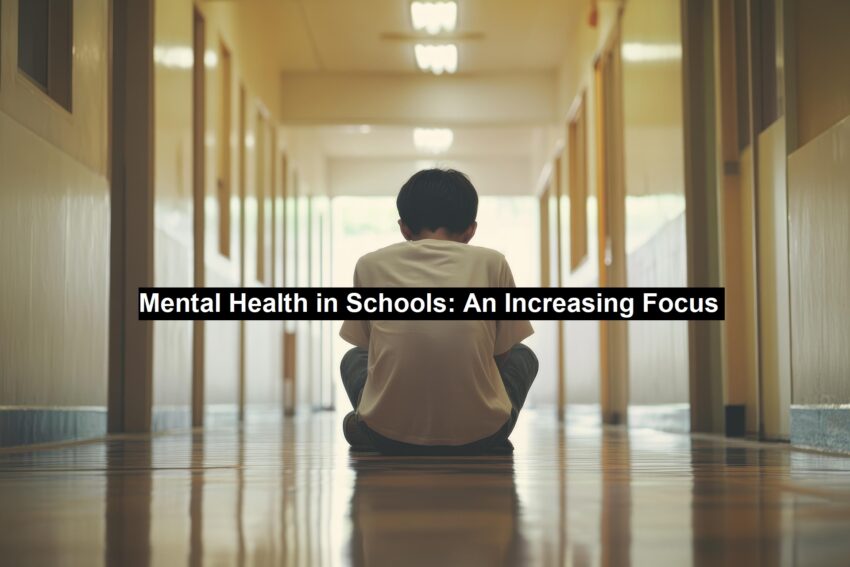
A simple yet powerful truth modern education is realizing is that mental health is equally as important as academics. Schools have started recognizing the need to serve as the first point of contact to grant mental health aid to students because education alone is not effective for holistic student development. According to Market Research Future (MRFR), the global Digital Mental Health Market is projected to grow from approximately USD 27.8 billion in 2024 to around USD 152.31 billion by 2034, reflecting an annual growth rate of about 18.5%
Schools as the Best Solution to Provide Mental Health Aid
Schools have the advantage of directly coming into contact with almost every child on a daily basis, making it easier to identify and address issues as they arise. According to a recent McKinsey report released in 2023, 40% of high school students were estimated to have experienced persistent sad or hopeless feelings, and a shocking 20% seriously considered suicide. Even more astonishing is that almost half the students suffering from mental health issues go unassisted professionally. This is in part due to a lack of mental health professionals working in schools, and budget cuts making it increasingly hard to provide the necessary support.
Market Expansion Screenshot of Thriving
Experts believe the global school psychological counseling service market stood at around USD 4.8 billion in 2023. It is expected to grow to nearly USD 9.2 billion by 2032. This growth is driven by the CAGR of USD 7.8%, which focuses on student mental health services in a school setting.
Read: How to Use AI in Data Engineering
Strategic Value: Why It’s Important To Act Now
A student who is struggling mentally will most likely exhibit learning difficulties. Emotional distress can lead to absenteeism, disengagement, and lower overall academic performance.
Early detection greatly reduces long-term expenses: Prompt screening and intervention not only avert later crises, but also reduce treatment costs, alongside lost productivity.
Equity imperative: Early and effective intervention is most needed from rural, minority, or underserved populations, and in areas with scant school resources, constituting the largest treatment gaps.
Addressing student mental health, with scalable intervention, places schools in a unique position to provide support to numerous students who would otherwise never receive care.
Best Practice with Evidence Based Interventions
A. Universal Screenings & Tiered Support
Pulse County Kentucky schools conducted universal behavioral health screenings and hired on-site clinicians, resulting in identification of 16% more students in need and enhanced connected support systems.
B. Multi Tiered Prevention & Intervention
Research backs a three-tiered model:
Tier 1: Whole-class SEL (social emotional learning) and resilience activities.
Tier 2: Targeted small-group interventions for students at risk.
Tier 3: Individual counseling and crisis intervention.
Worldwide, the FRIENDS programs are recognized by the WHO and have strong RCT evidence for the universal prevention and resilience in youth. Schools that adopt the FRIENDS curricula report lower rates of anxiety and depression, as well as stress-related disorders.
C. Peer Support Programs
Hope Squad is an example of a peer-led program that empowers students to identify distress and help seeking behaviors. Research indicates that schools implementing these programs experience a marked decline in the associated stigma and an increase in help-seeking behavior from non-member peers
D. Technology-Enabled Access
Deloitte points out the gap in India’s mental health workforce with only 0.29 psychiatrists and 0.07 psychologists for every 100,000 people. These remote tele-mental health and app-based services provide efficient and remote mental health care to students in tier 2 and 3 cities and rural areas. Schools are able to provide support to students who otherwise would not have access.
Emerging AI-based tools, such as the digital phenotyping of smartphones, have shown promise in monitoring the risk of suicidal thoughts, eating disorders, and insomnia in adolescents with a balanced accuracy score of 0.77 for the risk of ideation
Case Studies: Leading the Way
• Illinois (USA): Mandatory Student Screenings
In August 2025 Illinois became the first state in the USA to enforce annual mental health screening for students in grades 3 to 12. This law allows the state to be a leader in proactively assisting families to receive the appropriate services for mental health challenges long before a crisis occurs.
• UK: Financial and Social Consequences of Youth Mental Health Crisis
The report states that the UK is home to 1 in 5 children that are mentally unwell. This underreported crisis is expected to cost over £1 trillion in lost earnings over the lifetime of these children. The study strongly recommends that available mental health services in schools be greatly increased.
• India: Inclusive Support and Technology Scaling
In some areas of India, schools are employing mental health professionals and using telehealth to connect with ignored areas. Given the lack of available providers, the use of technology in providing services can be adapted to a wide range of economic conditions.
What Should Schools Do?
- Provide comprehensive prevention, early intervention, and acute care based services.
- Create collaborative relationships between educational institutions, health services, and local community providers.
- Recruit and train additional mental health providers, including counselors and wellness coaches.
- Create service delivery frameworks across stakeholders that have integrated governance systems.
Students, Families, and Society
Students’ mental health and academic achievement are connected to each other. A student with good mental health will be willing to learn and attend almost all the classes. Early mental health intervention improves outcomes, reduces crises, and enhances productivity, thus mitigating unemployment. Providing services in schools improves the gap in access for marginalized students.
Early intervention in mental health support enables the acquisition of skills such as emotional regulation and coping, which builds resilience.
Challenges and Their Solutions
- Licensed staff shortage: Many districts face this challenge. Digital wellness coaches and counselors as well as inter-agency collaborations can bridge the gap.
- Stigma and resistance: Normalizing the seeking of wellness through holistic SEL and peer programs.
- Financial limitations: Medicaid billing (in the U.S.), philanthropic partners, and a jointly combined phased rollout can help.
- Privacy and data security concerns: Privacy-related risks require ethical and youth-informed protocols when building digital tools.
Final comments
Mental health (specifically the digital mental health) concerns must be addressed proactively. The rising levels of anxiety, depression, and distress require the education system to implement universal screening, social and emotional learning (SEL), evidence-based interventions, peer-assisted support, and a technology-enabled approach. It is a sound moral and strategic investment to prevent crises, strengthen academic resilience, and promote sustained equity and economic opportunity.
Education systems that have incorporated mental health care into their frameworks have the potential to create contexts that enhance intellectual and emotional development. This fosters a resilient and confident generation to meet the demands of the future.